GDPR and Terms of Service: Checklist for EU Users
If you live or work in the European Union, the General Data Protection Regulation (GDPR) gives you effective privacy rights, but only if you know what to look f

Photo by RDNE Stock project from Pexels
If you live or work in the European Union, the General Data Protection Regulation (GDPR) gives you effective privacy rights, but only if you know what to look for in a service's terms and privacy policy. Most EU users skip the fine print, assuming the law protects them automatically. The reality is more nuanced: GDPR sets a floor, but companies can, and often do, ask for consent to practices that push those boundaries. This checklist walks you through the key clauses every EU user should audit before signing up, paying, or handing over personal data.
TL;DR
- GDPR requires explicit consent for data processing; if a company's terms don't make this clear, that's a red flag.
- Check for forced arbitration clauses: they can override your right to sue under EU consumer law.
- Auto-renewal traps are illegal under EU law (Omnibus Directive), but companies still hide them, look for explicit billing language.
- AI training on your data, affiliate sharing, and cookie consent must be opt-in for EU users, not opt-out.
- Use Terms Doctor's A-F grading and automated 101-check system to spot hidden data practices before you commit.
Why GDPR Matters for Your Terms of Service

The GDPR, which took effect in May 2018, fundamentally changed how companies handle data for anyone in the EU, the EEA, or even outside Europe if they offer services to EU residents. Unlike older privacy laws, GDPR assumes that you own your data and companies must prove they have a lawful reason, and your consent, to process it.
However, consent is where the trouble starts. Many terms of service bury consent requests under layers of policy links, use vague language like "improve our services," or ask for blanket permission to use your data in ways you never anticipated. GDPR says consent must be "freely given, specific, informed, and unambiguous", which means no pre-ticked boxes, no bundled consent, and no dark patterns that make opting out harder than opting in.
Key takeaway: GDPR gives you rights on paper, but you have to actively check whether a company's terms respect them.
What to Look For: The GDPR Red Flags in Terms of Service
Understanding the specific language that signals GDPR compliance problems will save you time and protect you before you even hit "Sign Up." Here are the most common warning signs:
1. Vague or Overbroad Consent Language
Red flag: "We may use your data to improve our services and develop new features."
What to do: Ask yourself: Does the company say exactly what they'll do with your data, newsletters, analytics, AI training, third-party sharing? If it's fuzzy, that's intentional. GDPR requires companies to be specific about each use case and ask separately for consent to each one.
Example: A productivity app might say "We process your documents with our AI to suggest improvements" (specific) vs. "We use your data to enhance your experience" (vague). The first is GDPR-compliant; the second is not.
2. Forced Arbitration Clauses
Red flag: "Any dispute will be resolved through binding arbitration in [non-EU jurisdiction]."
What to do: Flag this immediately. EU consumer protection law (especially the Unfair Contract Terms Directive and national laws) gives you the right to sue in your own country's courts. Many arbitration clauses override this right, forcing you to pay arbitration fees and fight in a private, non-transparent process with no appeal. GDPR and EU consumer law explicitly reject clauses that strip these rights.
3. Forced Auto-Renewal Without Clear Opt-Out
Red flag: "Your subscription renews automatically. Cancellation requires written notice sent to [obscure email] at least 60 days in advance."
What to do: EU law (the Omnibus Directive, enforced across all EU member states) requires that:- Cancellation be as easy as sign-up (usually one click).
- Renewal terms be shown before you're charged again.
- You receive a clear reminder before each charge.
4. AI Training or Data Monetization Without Explicit Opt-In
Red flag: "We may use anonymized data to train AI models and for research purposes."
What to do: Under GDPR, this is a separate processing purpose that requires separate consent. Don't accept "anonymized" as a free pass, anonymization is hard to prove, and GDPR still applies. If the terms don't offer a simple, no-friction way to opt out of AI training, they're likely non-compliant.
5. Sharing Data with "Service Providers" or "Partners" Without Naming Them
Red flag: "We share your data with third parties to provide our service and improve your experience."
What to do: GDPR requires companies to list or describe who those third parties are. "Service providers" is too vague. Push for specifics: What countries are they in? What do they do with your data? Are they bound by the same data protection rules? If the terms don't say, assume the worst.
How to Audit a Company's Terms: Step-by-Step Process

Most EU users skip this step or get lost in legal jargon. Here's a practical, quick workflow to audit any terms in under 10 minutes:
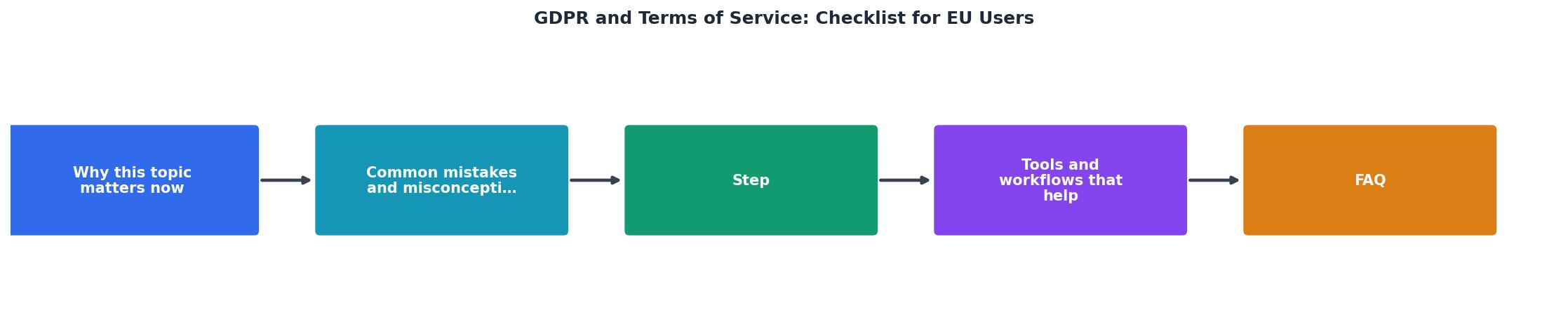
Step 1: Locate the Privacy Policy and Data Processing Agreement
Start at the company's homepage. Look for links labeled "Privacy Policy," "Terms of Service," "Data Processing Agreement," or "GDPR." Don't assume these are combined, they're often separate.
Pro tip: If you can't find a privacy policy or it's older than 2018, that's a serious red flag.
Step 2: Search for These Keywords
Use your browser's find function (Ctrl+F or Cmd+F) and search for:- "GDPR"
- "consent"
- "data processing"
- "AI" or "machine learning"
- "arbitration"
- "automatic renewal" or "auto-renew"
- "cookies"
- "third party" or "sharing"
Step 3: Cross-Check Against GDPR Principles
For each clause you find, ask:- Is consent specific (not bundled with other terms)?
- Is the purpose clearly stated?
- Can I easily withdraw consent later?
- Are my rights under EU consumer law (cancellation, refund, dispute resolution) protected or stripped?
Step 4: Use Terms Doctor to Automate the Heavy Lifting
Rather than manually hunting through dense legal text, use the free Terms Doctor extension to scan any site. It runs 101 consumer-protection checks and grades the terms A–F, highlighting forced arbitration, AI training clauses, auto-renewal traps, and other GDPR red flags instantly. You'll see a letter grade and a visual report without reading a single legal paragraph.
Your GDPR Terms of Service Audit Checklist
GDPR and Terms of Service Audit Checklist
Your progress is saved automatically in your browser.
Common GDPR Loopholes Companies Try to Exploit

Even companies that claim to be "GDPR-compliant" often slip in language designed to maximize data use while technically staying within the letter of the law. Here are the most common tricks:
The "Legitimate Interest" Claim
Many companies say they don't need your consent because data processing is in their "legitimate interest." This is true in some cases (e.g., fraud detection), but companies often overreach. If a company uses this language for marketing emails, AI training, or profiling, challenge it.
The "Anonymization" Escape Hatch
Companies love saying "we anonymize your data," implying GDPR no longer applies. In practice, anonymization is rare and hard to prove. Even "pseudonymized" data (ID numbers instead of names) is still protected under GDPR. If terms rely on anonymization, demand proof.
The "Service Provider" Shuffle
A company says a third party is just a "service provider" handling data on their behalf, so data sharing is fine. But if that third party combines your data with other sources, builds profiles, or sells insights, they're a data controller, not a service provider, and need separate consent from you.
"Most of the productivity tools used by businesses are now available with end-to-end encryption built in, including email, messaging, notes, and cloud storage.">, GDPR compliance checklist
The Jurisdiction Shell Game
A company says "GDPR applies, but disputes are resolved under [non-EU law] in [non-EU country]." This doesn't override GDPR, EU law applies regardless of what the terms claim. But arbitration clauses can force you into a costly, private process instead of court.
What Happens If a Company Violates GDPR?
If you spot GDPR violations in a company's terms, you have options:
- Contact the company. Many violations stem from outdated terms or lazy templates. A polite email pointing out the issue often prompts a fix.
- Report to your national data protection authority (DPA). Every EU member state has one (in Germany, it's the Bundesdatenschutzbeauftragte; in France, the CNIL; in Ireland, the DPC). They investigate complaints and can issue fines up to 4% of global revenue.
- File a complaint with a consumer rights organization. Groups like BEUC (The European Consumer Organisation) aggregate complaints and can push for enforcement.
- Opt out and leave a review. If terms are non-compliant, take your business elsewhere and leave honest feedback for other users.
Key Reminder: Your GDPR Rights Are Not Automatic
Even though GDPR grants you strong protections, companies often rely on the fact that most users never read the fine print. The checklist above is your shield—use it before every sign-up. If you spot violations, report them to your national data protection authority. Together, user vigilance and enforcement action push companies toward genuine compliance rather than performative compliance.
FAQ
Frequently Asked Questions
Get a Head Start with Terms Doctor
Reading terms of service is tedious, but it's essential for protecting your privacy and wallet, especially in the EU, where you have stronger rights. The free Terms Doctor browser extension takes the guesswork out: it scans any website's terms and privacy policy, runs 101 consumer-protection checks (including GDPR red flags), and grades the terms A–F in seconds. No legal degree required.
Remember: Automated checks are not a substitute for legal advice, but they're a fast way to spot the biggest risks and decide whether to dig deeper or walk away. Download Terms Doctor free for Chrome, Edge, Brave, Opera, and Vivaldi today, and audit any terms before your next sign-up.
Additional Resources
- GDPR compliance checklist - GDPR.eu - Are you ready for the GDPR? Our GDPR checklist can help you secure your organization, protect your customers' data, and avoid costly fines for non-compliance.
- GDPR Readiness Checklist - Information - do you have a Data Protection Policy? · Access - can you offer your users copies of any of their personal data that you process?
- Download GDPR Compliance Checklist for US Companies - Use our GDPR compliance checklist and expert advice to help navigate GDPR requirements and achieve compliance as a U.S. company.
Ready to Read Terms Before You Sign?
Terms Doctor finds terms of service on any site and grades them A-F in seconds.
Get Started“Terms Doctor flagged forced arbitration and AI training clauses in seconds. I finally know what I am agreeing to.”
Privacy-conscious shopper