
Photo by RDNE Stock project from Pexels
Every time you sign up for a B2B SaaS tool, project management, analytics, CRM, AI writing assistants, you agree to a Terms of Service document that quietly decides what happens to your data, your clients' data, and your legal rights. When the General Data Protection Regulation (GDPR) is in the picture, those terms carry even more weight. A single clause about sub-processors or data retention can turn a convenient software subscription into a compliance headache that lands on your desk months later. This guide breaks down the GDPR-related clauses you should look for in any B2B SaaS Terms of Service, gives you a practical checklist, and shows you how to speed up the review process without hiring outside counsel for every tool you evaluate.
TL;DR
- B2B SaaS Terms of Service must address GDPR obligations like data processing roles, sub-processors, data transfer mechanisms, and breach notification timelines.
- Look for a separate Data Processing Agreement (DPA) or DPA-equivalent clauses embedded in the ToS, if neither exists, that is a red flag.
- Forced arbitration, unilateral amendment rights, and vague data retention language are the three clauses that cause the most GDPR-related disputes.
- Automated tools like Terms Doctor can scan a vendor's ToS in seconds and flag missing GDPR safeguards before you sign.
- Reviewing terms is a smart habit, but it is not a substitute for professional legal advice tailored to your situation.
Why GDPR matters inside your SaaS Terms of Service

The GDPR does not only apply to companies headquartered in the EU. It applies whenever a service processes personal data of individuals located in the European Economic Area (EEA), regardless of where the SaaS vendor is based. That means a project management tool hosted in Virginia still falls under GDPR rules the moment a team member in Berlin logs in and the platform stores their name, email, or IP address.
Under GDPR, the company that decides why and how personal data is processed is the data controller. The SaaS vendor that processes data on the controller's behalf is typically the data processor. The Terms of Service, and the Data Processing Agreement that should accompany them, define which party plays which role, what data is processed, and what happens when something goes wrong.
"Most SaaS platforms are processors for customer data inside the product and controllers for their own CRM, HR, and marketing systems.">, GDPR for SaaS: A Complete Guide to Compliance for Software Companies
This dual-role reality is exactly why you cannot just skim the marketing page and assume compliance. The legal text is where the real commitments, or the lack of them, live.
The seven GDPR clauses to check in any B2B SaaS ToS

Not every Terms of Service document is structured the same way, but GDPR-relevant language tends to cluster around the same seven topics. Here is what to look for and why each one matters:
- Controller vs. processor designation, The ToS or DPA should explicitly state that the vendor acts as a data processor (or joint controller, if applicable). If the document is silent on roles, you have no contractual basis for holding the vendor accountable under Article 28 of the GDPR.
- Data Processing Agreement (DPA) availability, A GDPR-compliant relationship requires a written DPA. Some vendors embed DPA clauses directly in the ToS; others offer a standalone DPA you can countersign. If neither exists, treat it as a serious red flag.
- Sub-processor disclosure, Article 28(2) requires processors to inform controllers about any sub-processors (e.g., cloud hosting providers, email delivery services). Look for a publicly available sub-processor list and a mechanism to object to new additions. Many vendors publish this list on a dedicated page and commit to notifying customers before changes take effect.
- International data transfer mechanisms, If the vendor or any sub-processor stores data outside the EEA, the ToS or DPA must reference a lawful transfer mechanism: Standard Contractual Clauses (SCCs), an adequacy decision, or Binding Corporate Rules. After the Schrems II ruling, simply stating "we comply with GDPR" is not enough, specific safeguards must be named.
- Data retention and deletion, GDPR's storage limitation principle (Article 5(1)(e)) means data should not be kept longer than necessary. The ToS should state how long data is retained after account termination and whether you can request deletion on demand. Vague language like "we may retain data for a reasonable period" is a warning sign.
- Breach notification timeline, Under Article 33, processors must notify controllers "without undue delay" after becoming aware of a personal data breach. Best-practice DPAs commit to a specific window, commonly 48 or 72 hours. If the ToS says nothing about breach notification, you will have no contractual leverage if an incident occurs.
- Unilateral amendment rights, Many SaaS vendors reserve the right to change their ToS at any time with minimal notice. From a GDPR perspective, this is risky because a future amendment could weaken data protection commitments you relied on when you signed up. Look for clauses that require advance notice (30 days is a common standard) and give you the right to terminate if you disagree with the changes.
Step-by-step: how to review a SaaS vendor's ToS for GDPR compliance
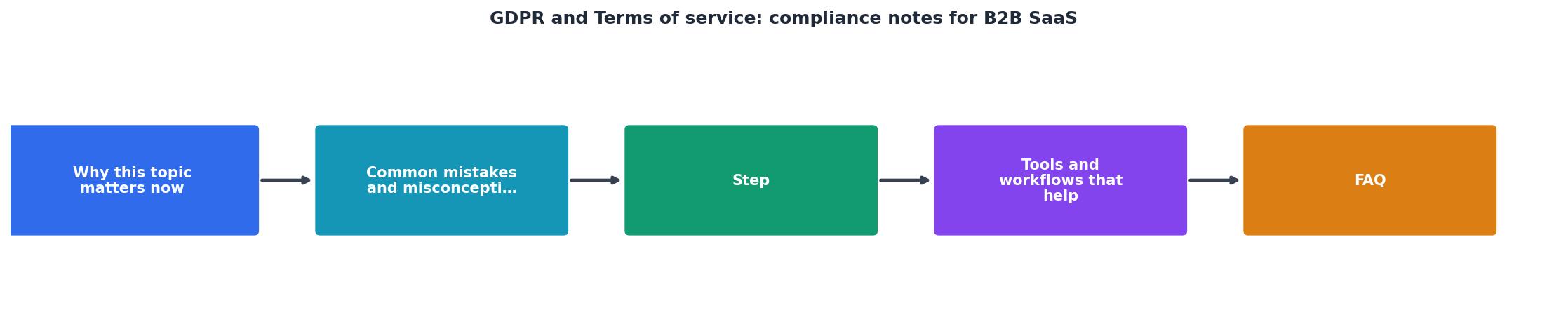
Follow these steps every time you evaluate a new B2B tool. The process takes about fifteen minutes with the right tooling, far less time than cleaning up a compliance issue after the fact.
- Locate the ToS and DPA, Visit the vendor's website footer or legal page. If you cannot find a DPA link, search the site for "data processing agreement" or "GDPR." Some vendors only surface the DPA during the enterprise sales process; if that is the case, request it before signing anything.
- Run an automated scan, Open the Terms Doctor extension while on the vendor's Terms of Service page. The extension automatically detects the ToS, runs 101 consumer-protection checks, and assigns an A-F grade. Pay special attention to flags related to data sharing, arbitration, and amendment rights.
- Check the seven clauses above, Use the list from the previous section as a mental checklist. For each clause, note whether the language is present, absent, or vague. Record your findings in a simple spreadsheet or your internal vendor-review template.
- Review the sub-processor list, Open the vendor's sub-processor page (if one exists) and verify that every listed entity operates in a jurisdiction with an adequacy decision or is covered by SCCs. Flag any sub-processors in countries without clear transfer mechanisms.
- Compare with previous versions, If you are renewing a subscription, check whether the ToS or DPA has changed since you last reviewed it. Terms Doctor's change-tracking feature can alert you to modifications so you do not have to re-read the entire document from scratch.
- Document your assessment, Save a dated copy of the ToS and DPA, your scan results, and any notes. GDPR's accountability principle (Article 5(2)) means you need to demonstrate that you performed due diligence, not just claim it.
- Escalate if needed, If the ToS contains red flags you cannot resolve, missing DPA, no breach notification clause, broad data-sharing permissions, escalate to your legal team or data protection officer before proceeding.
GDPR compliance checklist for B2B SaaS buyers
GDPR ToS Review Checklist
Your progress is saved automatically in your browser.
Common red flags that Terms Doctor catches

When you run Terms Doctor on a SaaS vendor's legal page, the extension highlights specific problem areas. Here are the red flags that overlap most with GDPR concerns:
- Broad data-sharing language, Clauses that allow the vendor to share data with "affiliates" or "partners" without naming them can violate GDPR's transparency requirements.
- AI training on user data, A growing number of SaaS tools include clauses permitting the use of customer-uploaded content to train machine learning models. Under GDPR, this typically requires a separate lawful basis and explicit disclosure.
- Auto-renewal with no cancellation window, While auto-renewal is primarily a consumer-protection issue, it also affects GDPR compliance: if you cannot easily terminate a contract, you cannot easily stop data processing.
- No mention of data deletion, If the ToS does not address what happens to your data after you cancel, assume the vendor has no formal deletion process.
- Forced arbitration in a non-EU jurisdiction, Clauses requiring disputes to be resolved through arbitration in, say, Delaware can make it practically impossible to enforce GDPR rights that are designed to be exercised in EU courts.
FAQ
Frequently Asked Questions
/legal/sub-processors or /trust/sub-processors. If you cannot find it, search the vendor's help center or contact their support team directly. A vendor that cannot or will not disclose its sub-processors is not meeting the transparency standard required by Article 28 of the GDPR.Speed up your next vendor review
Manually reading a 5,000-word Terms of Service document for every SaaS tool you evaluate is not realistic, especially when your team adopts new software every quarter. The free Terms Doctor extension for Chrome, Edge, Brave, Opera, and Vivaldi finds the ToS automatically, runs 101 checks covering forced arbitration, AI data training, auto-renewal traps, and more, then gives you a clear A-F grade with plain-language explanations. Install it once and you will never wonder whether a vendor's legal page hides a GDPR gap again. Just remember: automated checks are a effective first step, not a replacement for professional legal advice when the stakes are high.
Additional Resources
- GDPR for SaaS: A Complete Guide to Compliance ... - To meet GDPR expectations, policies should: Use plain, accessible language instead of legal jargon. Specify processing purposes, lawful bases, retention ...
- GDPR for SaaS Companies | Complete Compliance Guide - This page provides a full GDPR compliance blueprint for SaaS providers, including data mapping, user rights, DPIAs, consent, international transfers, logging,
- SaaS Terms of Service Legal Requirements 2026 - SaaS terms of service legal requirements have evolved for 2026: DPA clauses, limitation of liability, IP ownership, AI-specific terms, auto- ...