
Photo by Erik Mclean from Pexels
You just found the perfect project-management tool, the pricing looks fair, and the feature list checks every box. Before you hand over your credit card, you scroll to the terms of service, and buried in paragraph fourteen you spot the word indemnification. Suddenly you are on the hook for the vendor's legal bills if anything goes wrong, even if the fault is entirely theirs. Broad indemnification clauses are one of the most dangerous, and most overlooked, red flags in SaaS agreements, and they can expose individual users and small teams to financial risk that far exceeds the subscription fee.
TL;DR
- Indemnification means you agree to cover someone else's losses, including legal fees, damages, and settlements.
- Many SaaS terms include one-sided indemnification that protects only the vendor, not you.
- Broad language like "any and all claims arising from your use" can make you liable for things outside your control.
- These clauses often pair with forced arbitration and liability caps that further tilt the balance against users.
- Tools like Terms Doctor automatically flag indemnification red flags so you can spot them before you click "I agree."
What is indemnification and why should you care?

Indemnification is a contractual promise where one party agrees to compensate the other for certain losses. In a balanced contract, both sides indemnify each other: the vendor covers losses caused by its product defects, and the customer covers losses caused by its own misuse. That is fair.
The problem arises when the clause is one-sided and broadly worded. A typical broad indemnification clause in a SaaS agreement reads something like this:
"You agree to indemnify, defend, and hold harmless [Vendor] and its affiliates from and against any and all claims, damages, losses, liabilities, costs, and expenses (including reasonable attorneys' fees) arising out of or related to your use of the Service."
Notice the phrase "arising out of or related to your use." That language is so wide it could include a data breach caused by the vendor's own negligent security, a third-party integration the vendor recommended, or even a regulatory fine triggered by the vendor's non-compliant data processing. You, the customer, would still be expected to pay.
"The importance of such protection becomes most clear when we look at the data for negotiated contracts, where 72% of contracts contain customer indemnification obligations.">, What's Market in Customer Indemnification?
That statistic is for negotiated enterprise deals. In click-wrap SaaS agreements, the kind most of us accept without reading, the percentage is likely even higher, and the terms are almost never negotiated.
Key takeaway: A broad indemnification clause can make you financially responsible for the vendor's mistakes, not just your own.
How broad indemnification actually hurts SaaS users

Broad indemnification does not just sit quietly in the terms until something goes wrong. It shapes the entire risk profile of your relationship with the vendor. Here are the most common ways it can bite:
1. Unlimited financial exposure
Most SaaS subscriptions cost between ten and a few hundred dollars per month. A single indemnification claim, say, a patent-infringement lawsuit filed against the vendor where your data or usage is involved, can run into tens or hundreds of thousands of dollars in legal fees alone. The clause effectively removes any ceiling on what you might owe.
2. Chilling effect on legitimate complaints
If you discover the vendor mishandled your data and you want to file a complaint, the indemnification clause can be weaponized. The vendor may argue that your "use of the Service" contributed to the incident and counter-claim under the indemnification provision. Even if the argument is weak, the threat alone discourages users from asserting their rights.
3. Stacking with other unfavorable terms
Broad indemnification rarely travels alone. It often appears alongside:
- Forced arbitration, you cannot take the dispute to court.
- Class-action waivers, you cannot join other affected users.
- Liability caps for the vendor, the vendor's maximum payout is capped at the fees you paid in the last twelve months, while your indemnification obligation has no cap at all.
- Unilateral amendment clauses, the vendor can change the terms at any time, potentially broadening the indemnification scope after you have already signed up.
Red flags to watch for in indemnification clauses
Not every indemnification clause is equally dangerous. Here are the specific phrases and patterns that should raise your alarm:
- "Any and all claims", no limitation on the type of claim covered.
- "Arising out of or related to", the broadest possible causal connection; even tangential involvement counts.
- No carve-out for vendor fault, a fair clause excludes losses caused by the vendor's own negligence or willful misconduct.
- No cap on indemnification liability, the vendor's liability is capped, but yours is not.
- "Including but not limited to", an open-ended list that can expand to cover anything.
- Duty to defend, you must pay the vendor's legal fees upfront, not just reimburse after a judgment.
- Covers affiliates, partners, and third parties, your obligation extends beyond the vendor itself to an undefined group of related entities.
How to protect yourself: a step-by-step approach
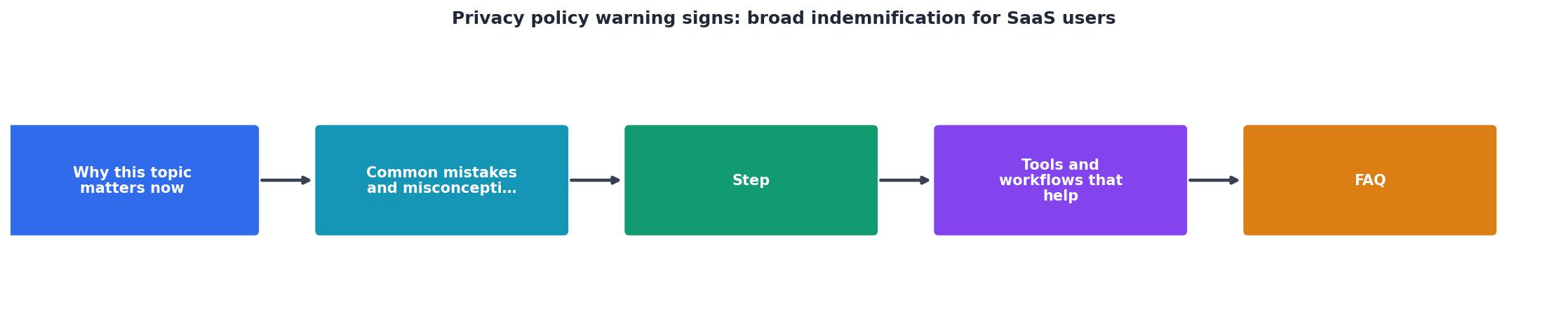
You do not need a law degree to reduce your exposure. Follow these steps before signing up for any new SaaS tool:
- Scan the terms automatically. Install the free Terms Doctor extension for Chrome, Edge, Brave, Opera, or Vivaldi. It locates the terms of service on any website and runs 101 consumer-protection checks, including indemnification scope, in seconds.
- Look at the grade. Terms Doctor assigns an A-F grade. Anything below a C deserves a closer look, especially if indemnification is flagged.
- Search for "indemnif" in the document. Use Ctrl+F to jump straight to the relevant paragraphs. Read them carefully with the red-flag list above in mind.
- Check for mutuality. Does the vendor also indemnify you for losses caused by its product? If not, the clause is one-sided.
- Look for a liability cap on your indemnification. A reasonable cap might be twelve months of fees paid. No cap at all is a serious warning sign.
- Compare alternatives. Terms Doctor lets you review multiple vendors side by side. If two tools offer similar features but one has a much fairer indemnification clause, choose the safer option.
- Negotiate if possible. For paid plans, especially annual or enterprise tiers, vendors will sometimes agree to narrow the indemnification language. Ask for a mutual clause with a reasonable cap and a carve-out for vendor negligence.
- Document your review. Keep a record of the terms version you accepted. Terms Doctor's change-tracking feature alerts you when a vendor updates its terms, so you will know if the indemnification clause gets worse after you sign up.
Your indemnification review checklist

Indemnification Clause Review Checklist
Your progress is saved automatically in your browser.
When broad indemnification is a deal-breaker
Not every broad indemnification clause means you should walk away. Context matters. A free tier with limited data exposure carries less practical risk than an enterprise plan where you upload sensitive client files. Here is a simple framework:
- Low risk: Free plan, no sensitive data stored, vendor has a strong security track record. The indemnification clause is still unfair, but your practical exposure is small.
- Medium risk: Paid plan, some business data involved, vendor has decent but not perfect security. Consider negotiating or at least documenting the risk.
- High risk: Enterprise plan, sensitive customer or financial data, vendor's terms include broad indemnification plus forced arbitration plus no liability cap. This is a deal-breaker unless the vendor agrees to modify the terms.
Note: This article is for informational purposes only and does not constitute legal advice. For specific legal questions about indemnification clauses, consult a qualified attorney.
Frequently Asked Questions
Take control of your SaaS agreements today
You should not need a legal team to understand what you are agreeing to. The free Terms Doctor extension for Chrome, Edge, Brave, Opera, and Vivaldi scans terms of service automatically, flags broad indemnification and 100 other consumer-protection issues, and gives you a clear A-F grade, all in seconds. Install it today and stop signing away rights you did not know you had.
Additional Resources
- SaaS Agreements: Key Contractual Provisions - Many parties will seek an indemnity for breach of contract but doing so cannot be justified as each party's remedy should lie in a breach of ...
- What's Market in Customer Indemnification? - Customer indemnification obligations require customers to protect vendors from specified claims, losses, or liabilities defined by contract.
- Contracting for Agentic AI Solutions: Shifting the Model ... - Indemnities are often broader, as they are designed to cover risks that arise from the way the service is performed.